Did you enjoy this article?
Subscribe for spiritual insights and new articles.
Prayers of the 21 Divisions: A Complete Devotional Guide
There are nights when the only real relief comes from a prayer said with faith. I've spent more than twenty years within the 21 Divisions, and this guide brings together traditional prayers directed at the main misterios of the pantheon, organized by purpose and by misterio, with the right context for using them, not just loose text with no explanation the way you find it everywhere else.
Some teachings and reflections on this tradition are also available in Spanish. You can explore the Spanish section here: Temas Espirituales.
In this guide you'll find:
- How to pray these prayers correctly
- A strong protection prayer
- A prayer to open paths
- Prayer to Anaisa Pye
- Prayer to Belié Belcán
- Prayer to Candelo
- Prayer to Santa Marta la Dominadora
- Catholic prayers to the syncretized saints
- The Holy Rosary: traditional prayer and its steps
- The mysteries of the rosary by day of the week
- Frequently asked questions
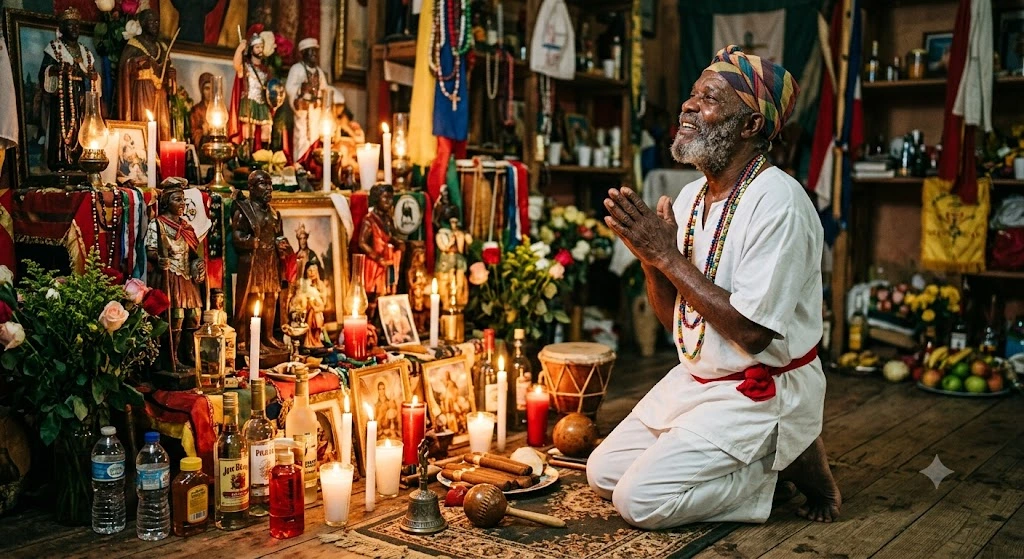
How to pray these prayers correctly
A prayer said from memory with no intention behind it doesn't carry the same weight as one said with faith and context. Before the specific prayers, here's what actually makes a prayer work within the practice.
- Be clear about what you're asking for. A confused request gets a confused answer. Before praying, sort out in your own mind exactly what you need.
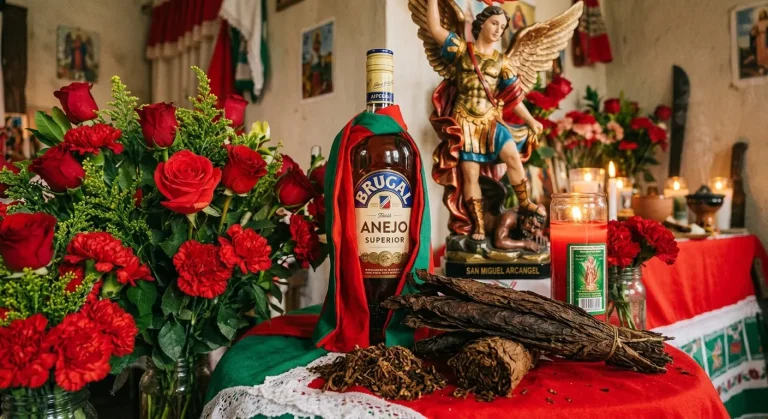
- Pair the prayer with a candle in the matching color when you can: green and red for Belié Belcán, yellow for Anaisa Pye, and so on by misterio.
- Pray in a calm space, ideally in front of an altar or an image of the misterio if you have one set up.
- Consistency matters more than intensity. A short prayer said every day is worth more than a long one said once and then forgotten.
A strong protection prayer
When you feel something circling you, whether it's envy, an evil eye, or a presence you don't recognize, this is a short prayer for immediate protection.
This prayer is a starting point. If your situation feels heavier than a rough patch, a full English guide to protection psalms and prayers is something I plan to publish soon, similar to a much deeper Spanish-language guide I already have live on the site.
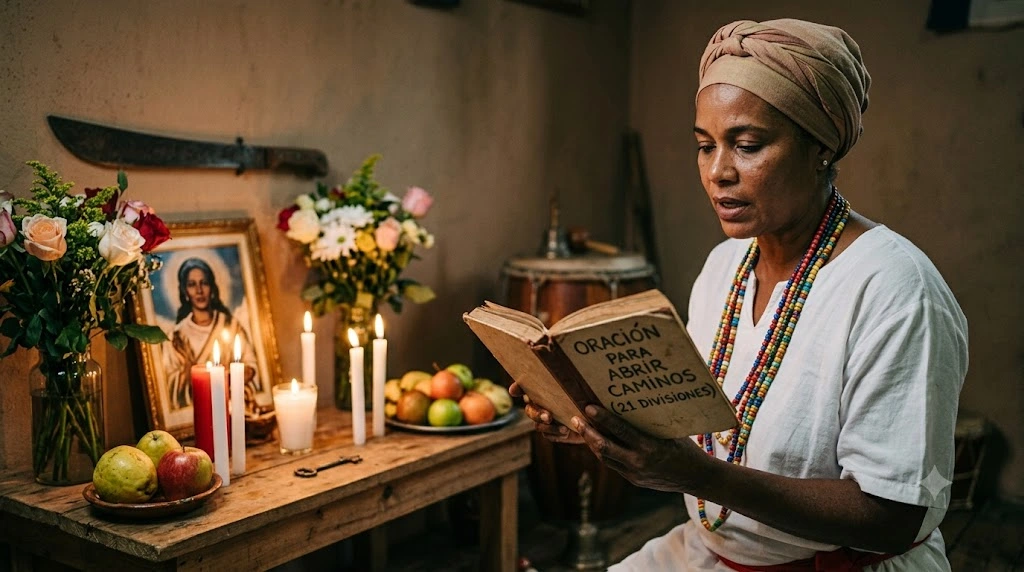
A prayer to open paths
Prayer to Anaisa Pye
For love, money, and the joy that Anaisa Pye represents within the White Division.
If you want to know her better in general, I already wrote about her in this article on Anaisa Pye, spirit of love, joy, and celebration.
Prayer to Belié Belcán
For protection, justice, and strength in the face of conflict, invoking the misterio syncretized with Saint Michael the Archangel.
Prayer to Candelo
For strength, transformation, and moving past obstacles that feel stuck.
Prayer to Santa Marta la Dominadora
For mastering difficult situations and gaining control over circumstances that feel out of your hands.
I've written a full, dedicated article on this devotion specifically: the complete Santa Marta prayer, on strength and Dominican Vodou, which goes deeper into her prayer and how devotees approach her.
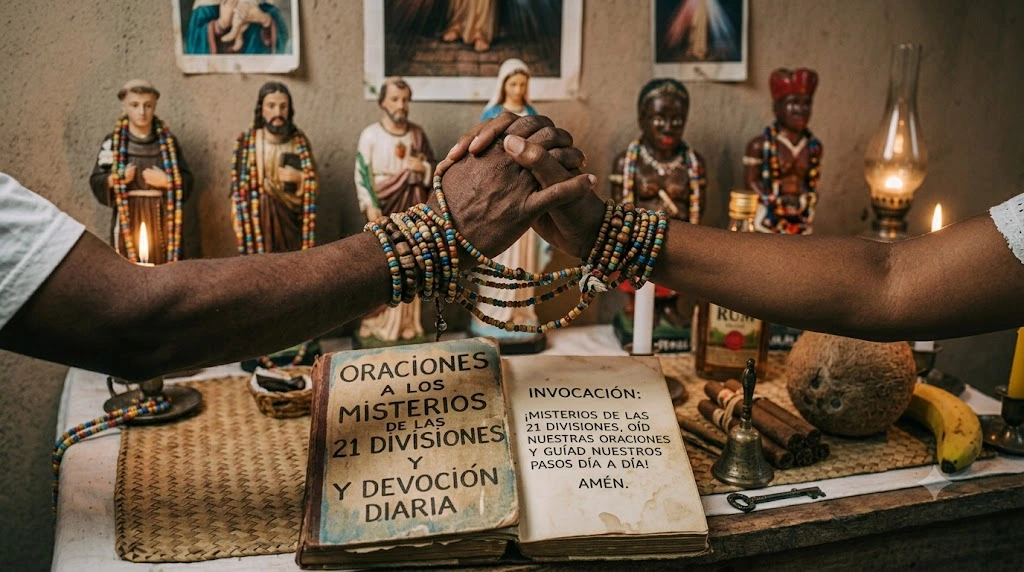
Catholic prayers to the syncretized saints
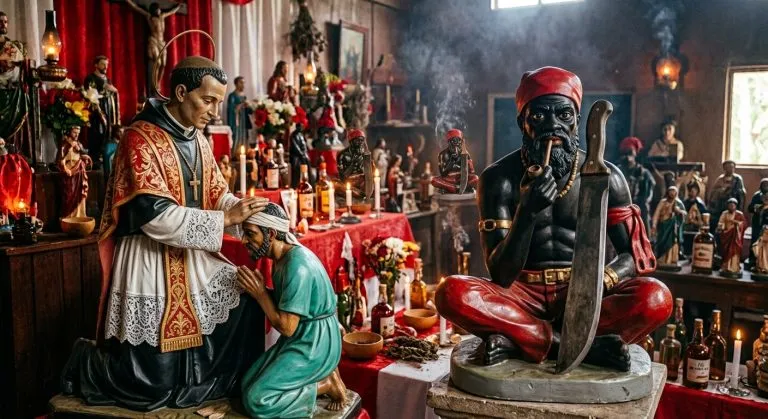
The 21 Divisions were born from a real syncretism between the African faith brought by enslaved people and the Catholicism imposed during colonial rule, a history covered in more depth in this guide to the 21 Divisions. Because of that shared history, alongside the prayer directed straight at the misterio, many servidores also pray the traditional Catholic prayer of the saint that misterio is syncretized with. Both devotions coexist within the practice, and this section gathers the Catholic prayers that correspond to each of the misterios above.
Prayer to Saint Michael the Archangel (Belié Belcán)
Prayer to Saint Anne (Anaisa Pye)
Prayer to Saint Charles Borromeo (Candelo Cedifé)
Prayer to Saint Martha
The Holy Rosary: traditional prayer and its steps
The rosary is one of the most consistent Catholic devotions in Dominican households, and many families who practice the 21 Divisions pray it alongside their prayers to the misterios, without seeing any contradiction between the two. Here are the traditional steps for praying it in full.
- 1. Make the Sign of the Cross, holding the crucifix of the rosary.
- 2. Pray the Apostles' Creed, holding the cross.
- 3. One Our Father on the first large bead.
- 4. Three Hail Marys on the next three small beads, traditionally offered for an increase in faith, hope, and charity.
- 5. One Glory Be.
- 6. Announce the first mystery of the day and pray one Our Father, ten Hail Marys, and one Glory Be. This makes up one "decade."
- 7. Repeat the same pattern for the five mysteries assigned to that day, each with its own decade.
- 8. After the fifth decade, pray the Hail Holy Queen to close the rosary.
Our Father
Hail Mary
Glory Be
Hail Holy Queen (to close the rosary)
The mysteries of the rosary by day of the week
Each day of the week has a different set of mysteries assigned for meditation during the rosary. Here are all four complete sets and the days they correspond to.
Joyful Mysteries — Monday and Saturday
- The Annunciation
- The Visitation
- The Nativity of Jesus in Bethlehem
- The Presentation of Jesus in the Temple
- The Finding of the Child Jesus in the Temple
Sorrowful Mysteries — Tuesday and Friday
- The Agony in the Garden
- The Scourging at the Pillar
- The Crowning with Thorns
- The Carrying of the Cross
- The Crucifixion and Death of Jesus
Glorious Mysteries — Wednesday and Sunday
- The Resurrection
- The Ascension
- The Descent of the Holy Spirit (Pentecost)
- The Assumption of Mary into Heaven
- The Coronation of Mary as Queen of Heaven and Earth
Luminous Mysteries — Thursday
- The Baptism of Jesus in the Jordan
- The Wedding at Cana
- The Proclamation of the Kingdom of God
- The Transfiguration
- The Institution of the Eucharist

Want guidance for your own devotional practice?
If you want to understand which prayers and devotions actually fit your situation, that's exactly what a consultation is for.
Book a ConsultationFrequently asked questions
Can I pray these prayers without being initiated in the 21 Divisions?
Yes. Devotion and prayer don't require prior initiation. Anyone can address a misterio with respect and faith, initiated or not.
How often should I say these prayers?
It depends on the purpose. Daily devotional prayers can be said every day, while prayers for protection or specific situations are recommended for as long as the need lasts, said consistently.
Do I need specific candles for the prayer to work?
A candle helps focus the intention and is traditional within the practice, but a prayer said with genuine faith has value even without one. The candle supports the intention, it doesn't replace it.
Can I change the wording of these prayers?
Yes. What matters is the intention and sincerity, not memorizing the exact text word for word. You can adjust the wording to how you naturally speak as long as you keep the respect and the purpose of the request.
Does praying the rosary go against practicing the 21 Divisions?
No. The tradition itself was born from the syncretism between Catholicism and African and Indigenous beliefs, so both devotions coexist naturally in many households. Praying the rosary and honoring the misterios aren't opposing practices.
How do I know which rosary mysteries to pray today?
It depends on the day of the week: Joyful on Monday and Saturday, Sorrowful on Tuesday and Friday, Glorious on Wednesday and Sunday, and Luminous on Thursday. This guide includes the full list for each set.
The prayers directed at the misterios are original compositions by the author, written within the traditional framework of the 21 Divisions, and reflect more than twenty years of direct experience within the practice. The Catholic prayers (Our Father, Hail Mary, Glory Be, Hail Holy Queen, Saint Michael, and the prayers to the syncretized saints) are traditional, widely known public domain prayers.
Did you find this article helpful?