What is Sanse and the 21 Divisions and what is the real difference between both traditions?
The question comes up more often than many admit. And it's no coincidence. Sanse and the 21 divisions look so similar on certain points that, at first glance, they seem like the same thing… but when you live it up close, when you step into the altar space, when you hear how a spirit rises… that's where the difference begins to show.
Some teachings and reflections on this tradition are also available in Spanish. You can explore the Spanish section here: Temas Espirituales.
For those approaching these paths for the first time, the confusion is understandable. Both systems use candles, herbs, prayers, and a deep veneration for spirits. However, they are like two rivers that originate in different mountains and, although their waters sometimes touch, they flow with different temperatures, rhythms, and destinations. In this article, we will thoroughly explore each one, their origins, their practices, and above all, their fundamental differences, so you can understand which one resonates more with your spiritual path.
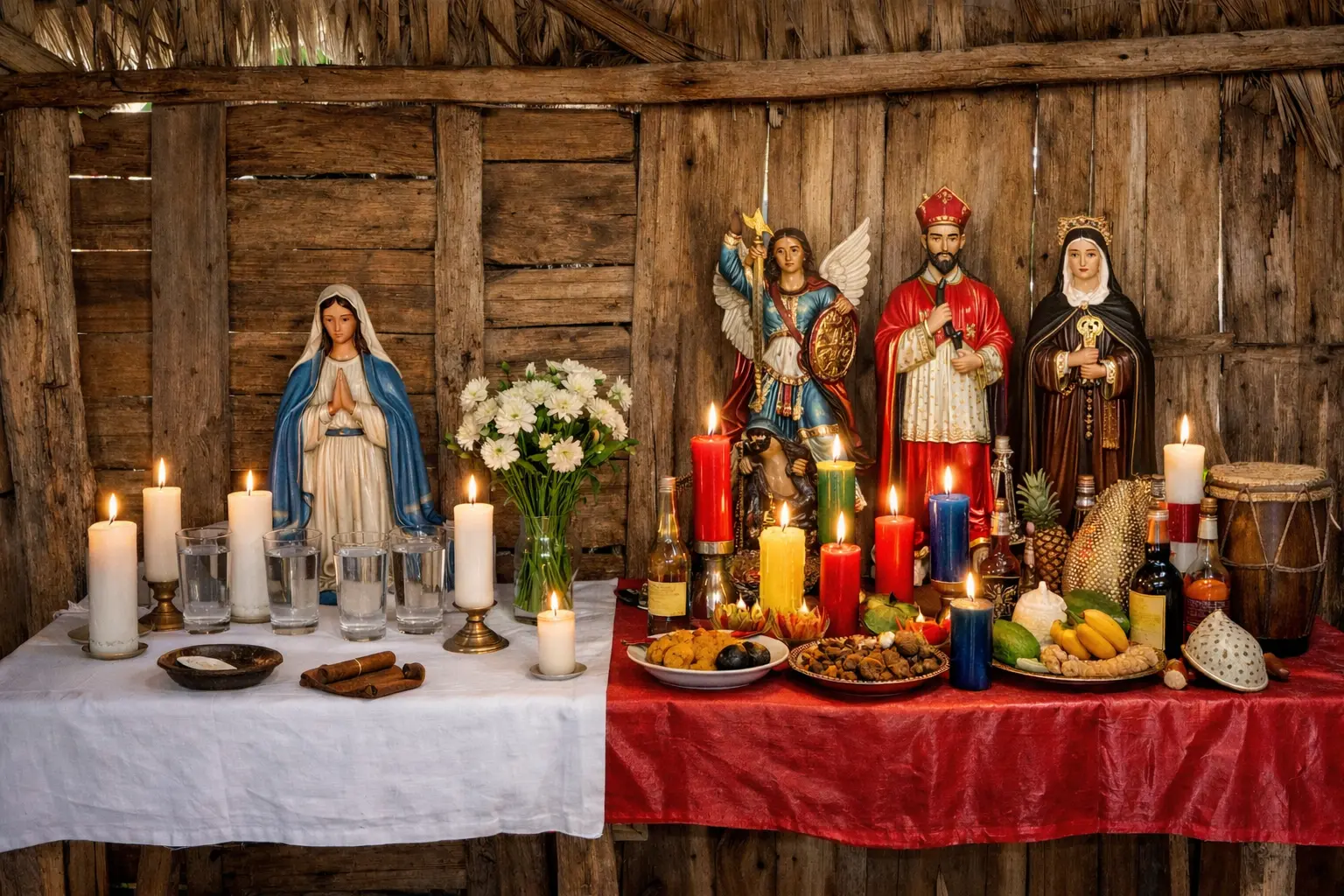
Table of Contents
- What is Sanse?
- Origin and history of Sanse
- What are the 21 divisions?
- Origin and history of the 21 divisions
- Key differences between Sanse and 21 divisions
- The role of Mysteries, Guides, and the Dead
- How each tradition is practiced: ceremonies and rituals
- Initiation, baptism, and spiritual development
- Spiritual hierarchy and lineages
- Spiritual reflection: which is your path?
- Frequently Asked Questions
What is Sanse?
Sanse is not a copy of the 21 divisions. Nor is it an incomplete version. It is something else. A living blend, a practice born from the encounter between Creole spiritism, Puerto Rican brujería, and elements of the 21 divisions. This mixture is not uniform. It changes according to the house, the lineage, the spiritual development of the practitioner.
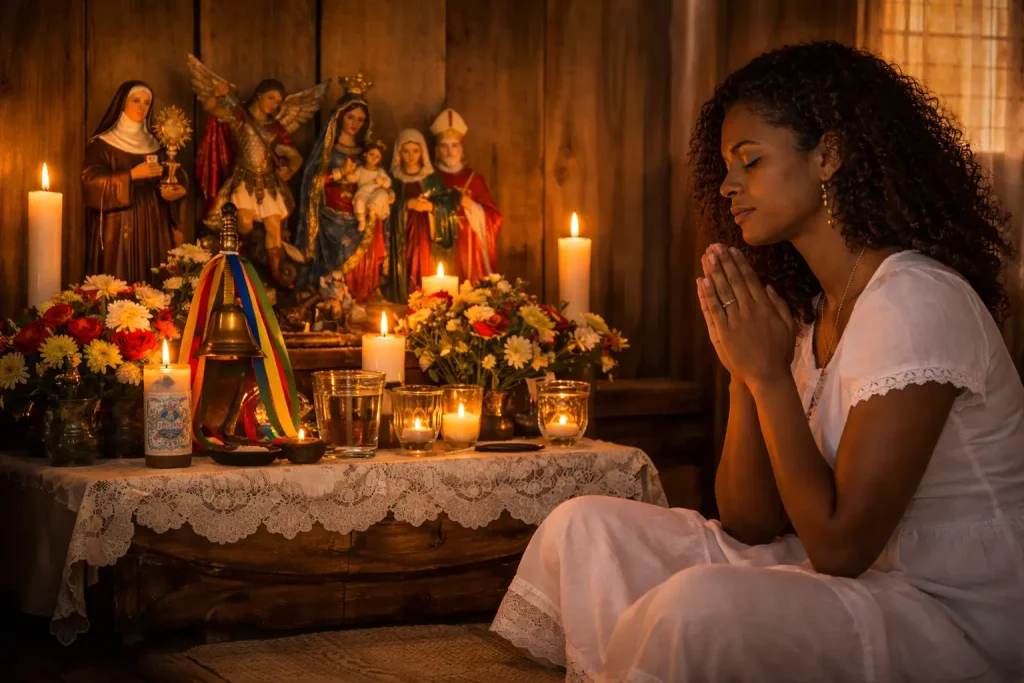
In Sanse, spiritual guides carry a weight not always seen the same way in other traditions. They are intermediaries. They are the ones who bring messages, do the work, perform cleansings. Sometimes the Mystery does not rise directly. It manifests through the guide. This changes the entire dynamic of the altar. Sanse is, in essence, a more flexible, more domestic system deeply tied to the land and ancestral family. It does not require large structures or elaborate temples; it is practiced at the spiritist table, in a corner of the home, with a Bible, a glass of water, and lit faith.
If you want to better understand the foundation of this tradition, you can start here: 21 divisions consultations
Origin and history of Sanse
To understand Sanse, you must travel to the Puerto Rican countryside of the 19th century. There, where sugarcane and coffee workers brought the beliefs of their African ancestors (mainly from the Congo and Angola regions), the indigenous Taíno, and the popular Catholicism of Spanish colonizers. Sanse (whose name likely derives from "Sansé," a deformation of "Congo" or from ceremonies similar to "Vodou" brought by French immigrants from neighboring islands) was born out of necessity: to heal, protect, and solve daily problems when there were no doctors or priests available.
Unlike other more organized traditions, Sanse was transmitted orally, from grandparent to grandchild, from aunt to niece. That is why there are so many variants. One Sanse house can be very different from another, but all share a deep respect for family dead ("dead by blood") and for guides who earn their place at the table through constant work. It is not a religion in the strict sense, but rather a way of life, a set of spiritual practices to navigate the visible and invisible world.
What are the 21 divisions?
The 21 divisions carry a different weight. Another root. Here, the center is the Mystery. Not the guide. Not the dead one. The Mystery. The connection is more direct, more intense, more demanding.
The system is organized into spiritual divisions, each with its own energy, function, and way of working. It is not symbolic. It is practical. It is lived in ceremony, in promise, in service. The 21 divisions, also known as "Dominican Vudú" or "Dominican Santeria", is a much more structured and hierarchical system than Sanse. It arrived on the island of Hispaniola (Dominican Republic and Haiti) with slaves from various regions of Africa, mainly from present-day Benin, Nigeria, and Congo, and blended with Catholicism and the Spiritism of Allan Kardec.
If you are beginning or looking to deepen your knowledge, this resource can help you: 21 divisions book complete guide
Origin and history of the 21 divisions
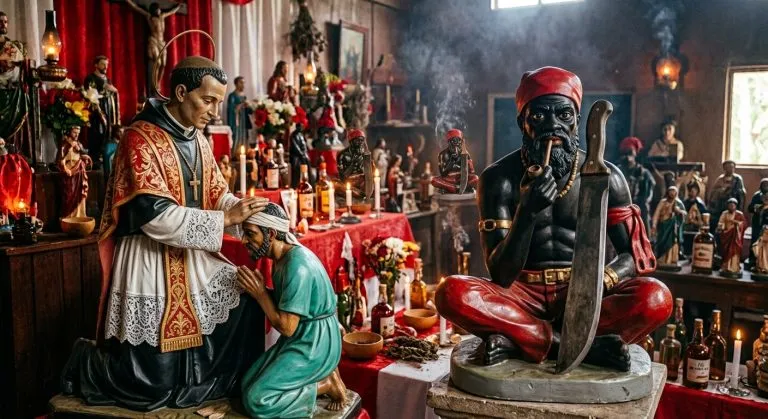
The Dominican 21 divisions have a history marked by resistance and organization. During the colonial period, enslaved Africans could not practice their religions openly. That is why they "mounted" their mysteries and loas behind images of Catholic saints. Thus, Ogún Balendjo hid behind Saint James the Greater, and the beautiful Metresili (Erzulie) found her face in the Sorrowful Virgin.
The number 21 is not random. It represents totality, the sum of the energies of the universe. Each division (such as the Division of the Guedes, the Indian Division, the Petro Division, etc.) groups together a set of mysteries that work in harmony but with specific functions. Unlike Sanse, the 21 divisions have a more unified body of knowledge, with songs (cantos), drumbeats (palos, palo alto, palo bajo, or palo de muerto) and a liturgy that remains relatively constant from one house to another, especially in the Dominican Republic and the diaspora.
Key differences between Sanse and 21 divisions
Here is where the confusion clears up a bit… or gets more complicated, depending on how you look at it.
The main difference is not in the names of the spirits. Many names are the same. Candelo. Metresili. Barón. They are on both paths. Even some mysteries like Anaísa, the owner of joy, or Belié Belcán, the fierce warrior, appear in both traditions.
The difference lies in how they are worked.
In the 21 divisions, possession (montarse or subir misterio / rising a mystery) is central. It is the language of the Mystery. Not everyone can receive certain rituals if they are not called to mount. When the Mystery rises, the person (the horse) fades into the background. The Mystery speaks, dances, advises, and works directly. It is an undeniable, powerful, and sometimes violent experience in its manifestation. This marks a clear line.
In Sanse, possession is not mandatory to serve. One can work from other spiritual faculties: clairvoyance, materialization, psychophony (hearing voices), or simply heightened intuition. Communication is more subtle. One can be a great santero without ever needing to mount a mystery. This opens the path to another type of more internal and silent development.
The focus also changes. In Sanse, one often works on the cause (a kind of sending, a stuck dead spirit, or a curse) through cleansings, herb baths, and prayers. The karmic or ancestral origin is investigated. In the 21 divisions, the work can lean more towards the ritual, the ceremonial, the direct: a fire cleansing, a powerful binding spell, a specific offering at the foot of a sacred tree. It is not that one is better than the other, but that they operate on different frequencies.
These differences have been observed within the real practices of both traditions.
The role of Mysteries, Guides, and the Dead
Here is a point that many overlook and that defines almost the entire practice.
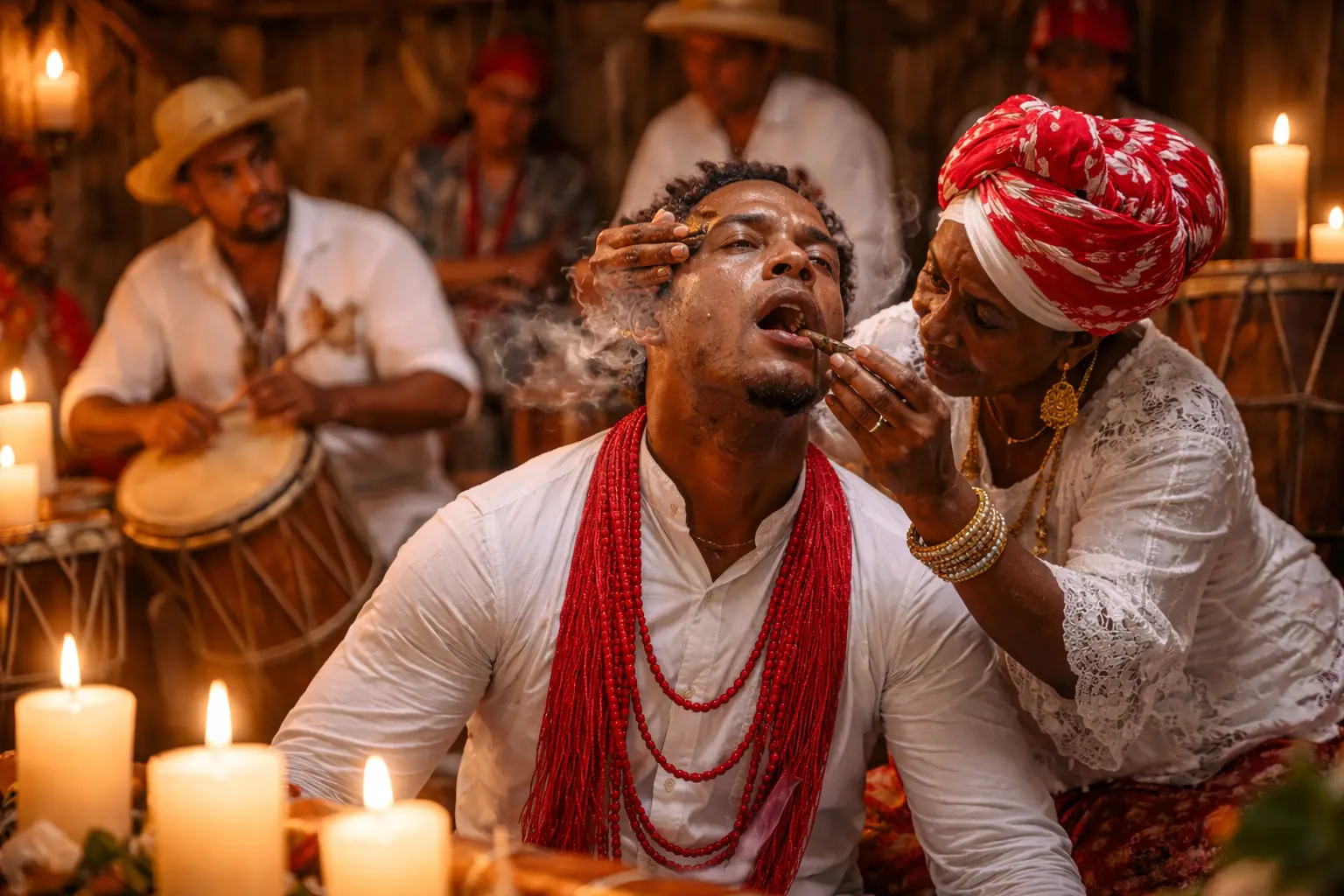
In the 21 divisions, the Mystery rises. It manifests. It takes the body. It works directly. The mysteries are not "common dead spirits." They are elevated entities, forces of nature, divine archetypes that have been covenanted and have a clear hierarchy. A mystery like El Barón del Cementerio (Baron of the Cemetery) is not the soul of a man who died; it is the very energy of death, sexuality, and fertility. That is why it is feared and respected in a different way.
In Sanse, the guide (who is often a light-filled dead person, an ancestor, or a spirit who has already had several lives) is the one who opens the path. It is the one who speaks. It is the one who sustains the work. The "Mysteries" or "Potencias" are above, but communication is more indirect. They are greeted and offered to, but it is not common for them to "descend" to possess someone. The guide is like an ambassador who presents your case to the court of the Mystery.
That does not mean one is stronger than the other. It means they are different paths. In the 21 divisions, you face the Mystery face to face. In Sanse, you walk hand in hand with your guide or emissary to reach it.
If you are looking to experience this in a guided way: personalized spiritual consultation
How each tradition is practiced: ceremonies and rituals
Practice also reveals a lot.
In the 21 divisions, there is more presence of drumming (palos), singing (songs for each division), movement, and dance. The ceremony (the "mass" or "fiesta") is communal. Three main palos are played: the Alc. Pallos (major drum), the Alc. Piquete (medium drum), and the Alc. Balsie (small drum), along with the guira (güira) to mark the rhythm. The energy rises. It is felt in the body. It is active, loud, festive, and cathartic. People fall into trance, mysteries ride, blessings and warnings are dispensed. It is a social and spiritual event at the same time.
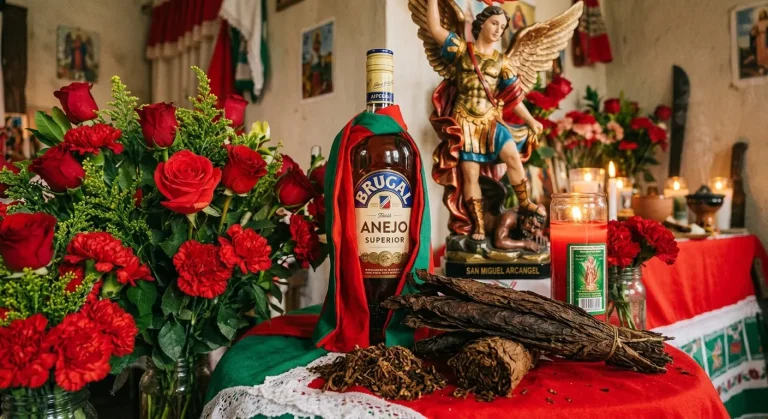
In Sanse, many ceremonies are more reserved. Quieter. More focused on prayer, candlelight, concentration, and the spiritist table. Candles of different colors are lit according to the work, glasses of water are placed for the dead, tobacco is smoked to open paths, but the atmosphere is more intimate. It can be a single person in front of their altar. No drumming, no ecstatic dancing. There is concentration, channeling, and silent energy work.
Both have power. Both work. But they are not lived the same way. One is a symphony of percussion; the other, a poem recited in a low voice.
Initiation, baptism, and spiritual development
The entry path is another important point of divergence.
In the 21 divisions, baptism or initiation (head washing, "head refreshment," or "initiatory ceremony") is almost always necessary to exercise power. It is not a simple procedure. It is a ceremony where you are "presented" to the mysteries, your head is washed with special waters and herbs, and you are assigned a spiritual "father or mother." Without this baptism, you can be a devotee, but you will not have the authority to perform certain heavy works or to be a firm "horse" for a mystery. No one chooses the 21 divisions; the 21 divisions choose you.
In Sanse, development is more gradual. You do not need a major initiation to begin. You can start with your white table, your guides will come to you gradually, asking for things. Over time, if the house requires it, you can receive a "promotion" or a "consecration," but it is not the standard. Many pure-blooded santeros never received a formal baptism in a large house. They simply "developed" their faculties with the help of a mentor. It is a more democratic path, but also slower and prone to deviations if there is no firm guidance.
Spiritual hierarchy and lineages
The 21 divisions have a clear hierarchy of mysteries. For example: The First Division is the Division of the Rada Rites (the most ancient). Then come others up to the Division of the Guedeses (death). Within this hierarchy, there are kings, queens, princes, princesses, soldiers, etc. A servant of the 21 divisions knows which division each mystery belongs to and what its rank is. This organizes spiritual work like a royal court.
Sanse is much more horizontal. There is no universally accepted hierarchy of guides. Your main guide could be a deceased grandmother, an old peasant from the hills, or a gypsy spirit. There are no "kings" or "princes" in classic Sanse. Respect is earned through the effectiveness of the work, not the spirit's title. This makes Sanse more adaptable, but sometimes more confusing for newcomers, since what works in one house may not be recognized in another.
Spiritual reflection: which is your path?
In the end, the question is not which one is better.
The question is which one calls you.
If you feel drums at night, if mysteries appear to you in dreams with the faces of saints, if your body sometimes moves without you commanding it, if the energy asks for celebration and festivity… then your path is probably that of the 21 divisions.
If you prefer the silence of a candle in your room, if you feel more comfortable talking with your deceased grandparents than with a powerful entity, if your spirituality is more intimate and home-based, if water in a glass tells you more than a drum… then perhaps Sanse or Creole Spiritism is your refuge.
Because there are paths that are studied… and there are paths that take you.
And when that happens, the difference ceases to be theory.
It becomes experience.
Explore more about this path
Follow me for more spiritual content
- Facebook espiritual
- YouTube Ruben Ricart
- YouTube Temas Espirituales Show
- Instagram Temas Espirituales
- Instagram Ruben Ricart
- TikTok espiritual
Frequently Asked Questions
Are Sanse and 21 divisions the same thing?
No. Although they share spirits and elements (like Candelo, Metresili, or the Baron), the way of working, the spiritual structure, the emphasis on possession, and the type of ceremonies are different. Sanse is more domestic and flexible, while the 21 divisions are more hierarchical and ritualistic.
Which is stronger, Sanse or 21 divisions?
It is not measured that way. Each tradition has its strength depending on the spiritual development and the person's path. The 21 divisions can be more forceful and fast due to direct work with the mysteries. Sanse can be more personal and focused on ancestral issues. The "strength" lies in the practitioner, not the system.
Can I practice both?
Yes, but it requires a lot of guidance and care. It is not something to be mixed without deep knowledge. On some Caribbean islands, it is common to find people who practice "Sanse with 21 divisions," but these are usually very specific lineages. For a beginner, it is recommended to choose one path and respect its rules before attempting to synchronize them.
Do I need initiation to practice?
In the 21 divisions, in many cases yes, especially for certain rituals or to be a "horse" for a mystery. The spiritual calling is mandatory. In Sanse, initiation is not strictly necessary at the beginning, but it is highly recommended to have a mentor or guide to avoid spiritual mistakes. You can start with your table and your prayers, but for major works, seek a serious house.
What is the role of Catholic saints in both traditions?
In both traditions, Catholic saints are used as a "mirror" or "mask" for the mysteries and guides (syncretism). However, in the 21 divisions it is more structured (e.g., the Sorrowful Virgin is a facet of Metresili). In Sanse, it can be more flexible; sometimes one works directly with the saint without linking them to an African mystery, especially in the more Spiritist branches.
Can I have an altar for Sanse and one for 21 divisions in my house?
It is not recommended unless you know very well what you are doing. The energies are different and can create confusion or spiritual conflicts in your home. If you feel an affinity for both, consult with a godfather or godmother who has experience in synchrony. It is better to have one well-ordered altar than two messy ones.