Did you enjoy this article?
Subscribe for spiritual insights and new articles.
What is the difference between Haitian Vodou and 21 Divisions Dominican Vodou?
People ask this question a lot, and it makes sense that they do. Both traditions share roots, spirit names, and enough surface-level resemblance that conflating them feels almost reasonable until you actually sit inside one of them. Watch a ceremony. Pay attention to how people talk about the spirits, what instruments are played, what language the prayers move in. That's when the separation starts to feel real. These are not two names for the same thing. They are two distinct spiritual systems that grew out of different soils, different colonial pressures, different centuries of survival.
Some teachings and reflections on this tradition are also available in Spanish. You can explore the Spanish section here: Temas Espirituales.
Haitian Vodou and 21 Divisions share African ancestry, yes. There is genuine overlap in places. But there is also clear divergence in structure, ritual logic, and how each tradition understands its own relationship to Catholicism, to the dead, to spirit. Getting into those differences means going beneath the surface, into initiation, into instrumentation, into what the spirits are even called.
Table of Contents
- Origins and Historical Development
- Core Spiritual Structure
- Lwa vs Misterios
- Ritual Practices and Ceremonies
- Language and Cultural Expression
- Role of Catholic Influence
- Priesthood and Spiritual Authority
- Spirit Possession and Interpretation
- The "Tchatcha" Lineage Connection
- Key Differences at a Glance
- FAQ
- References
Origins and Historical Development
Haitian Vodou came out of Saint-Domingue during the colonial period, shaped by enslaved Africans from Dahomey (modern Benin), Kongo, Yorubaland, and other regions. Hebblethwaite's A Transatlantic History of Haitian Vodou [1] traces the political and slave-trading histories of the Bight of Benin kingdoms closely, showing how those specific histories of forced displacement created the conditions for Vodou to emerge. French colonial policy tried to keep African nations separated. Enslaved people did the opposite, pulling their spiritual knowledge together into something unified. That unified system eventually played a role in the Haitian Revolution (1791–1804). Bellegarde-Smith and Michel's edited volume Haitian Vodou: Spirit, Myth, and Reality [2] documents how Vodou organized rural resistance and shaped political transformation across Haiti.
21 Divisions took a different road entirely. Luis Peguero Guzmán, writing in Ciencia y Sociedad [3], argues that Dominican magical-religious expression grew out of a distinct historical situation, one shaped more heavily by Spanish Catholicism and Indigenous Taíno presence than by the plantation dynamics that defined Saint-Domingue. The Dominican colonial experience was less uniformly intense, and the Catholic Church was more embedded in everyday life. What emerged feels less centralized. It moves through local spiritual houses rather than anything like a national structure. The name "21 Divisions" itself reflects a numeric framework that Haitian Vodou doesn't organize around in quite the same way, though scholars like Rachel Beauvoir-Dominique have noted a parallel "twenty-one nations" structure within Haitian Vodou as well [4].
Core Spiritual Structure
Haitian Vodou has a more defined internal cosmology. Spirits are grouped into nations (nanchon), with Rada representing cooler, ancestral spirits, Petwo carrying a fiercer, revolutionary energy, and Ghede presiding over death and fertility. Hebblethwaite's research focuses on the Rada and Gede rites specifically, tracing them through ethnographic fieldwork and the careful documentation of Vodou songs [1]. Each nation comes with its own rhythms, colors, foods, and expectations. Scholars like Beauvoir-Dominique and Desmornes have catalogued anywhere from a dozen to over a hundred spirit names within a single spiritual nanchon [4].
21 Divisions organizes spirits into divisions. División Blanca carries associations with saints, healing, and benevolent forces. División India connects to Indigenous Taíno spirits, nature, and herbal knowledge. División Negra links to African ancestors and more protective, intense work. Peguero Guzmán's comparative work notes that while both traditions share African roots, the organizational principles in Dominican practice reflect a different popular religiosity altogether [5]. The number 21 is symbolic. Not all lineages interpret it literally.
Lwa vs Misterios
In Haitian Vodou, spirits are lwa (also loa). They function as intermediaries between Bondye, the supreme creator, and human beings. Bellegarde-Smith and Michel's volume documents lwa personalities and preferences in detail, including an appendix listing their distinct songs and characteristics [2]. Papa Legba opens gates. Ezili Freda is coquettish and loving. Ogou is a warrior spirit. Each carries a specific character that practitioners know well.
In 21 Divisions, spirits are lwa but also called Misterios, which translates to mysteries. Some Misterios correspond to Haitian lwa, but their identities often blend with Catholic saints and with local spiritual interpretations that have developed over generations in the Dominican context. Peguero Guzmán is careful about this distinction, noting that characterizing Dominican magical-religious expression accurately means keeping it separate from the Haitian system, which is "classically recognized as Vodou" [3]. The relationship practitioners have with Misterios tends to feel more devotional, less bound to formal structures.
Ritual Practices and Ceremonies
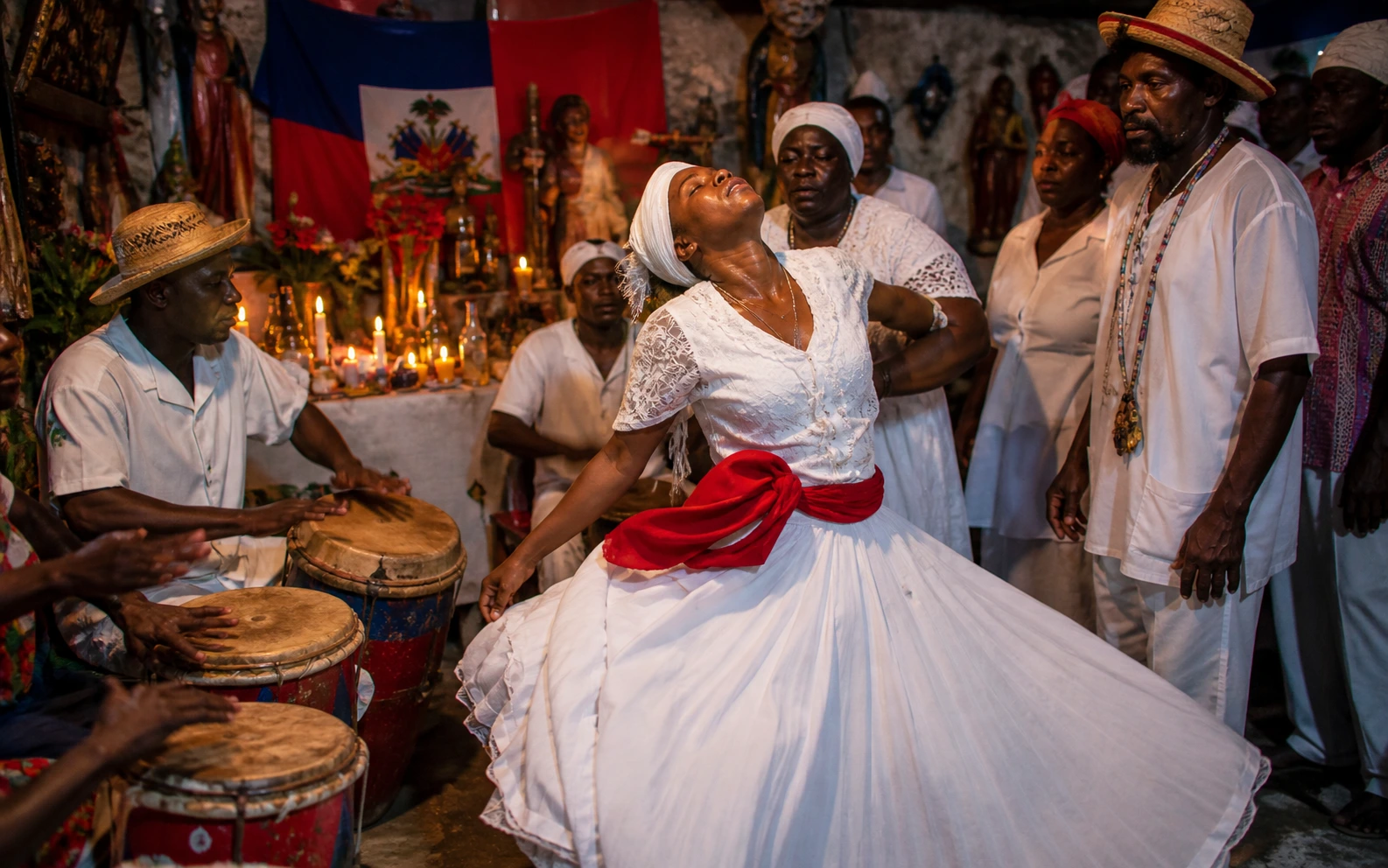
Haitian Vodou ceremonies tend to follow established sequences. Drumming patterns differ by nation: rada rhythms for Rada spirits, petwo rhythms for Petwo. Hebblethwaite's ethnomusicological analysis shows how Vodou songs carry historical and religious knowledge, maintained through careful ritual tradition across generations [1]. Invocations include drawing vèvè, ritual symbols traced on the ground using cornmeal or ash. Ethnographic archives from Luc de Heusch and Lilas Desquiron document Rada cult practices in considerable detail, including the sacred objects used to call spirits [6].
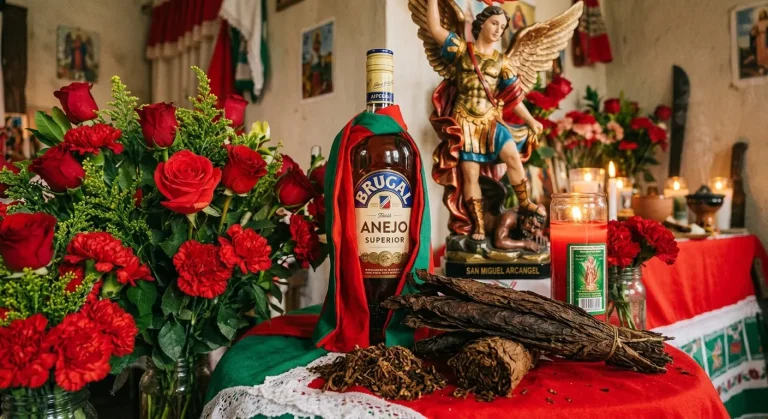
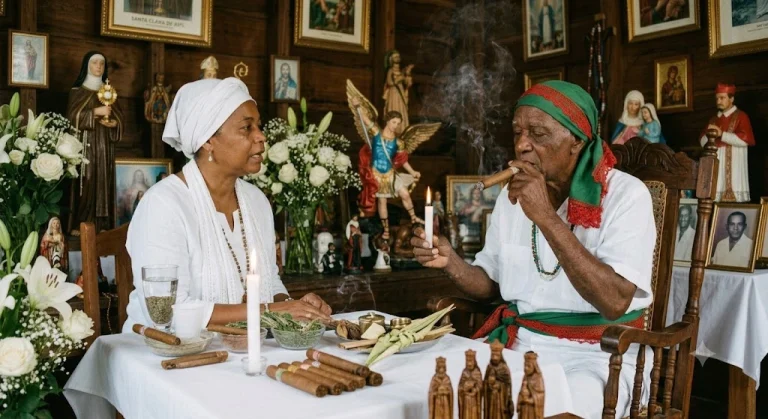
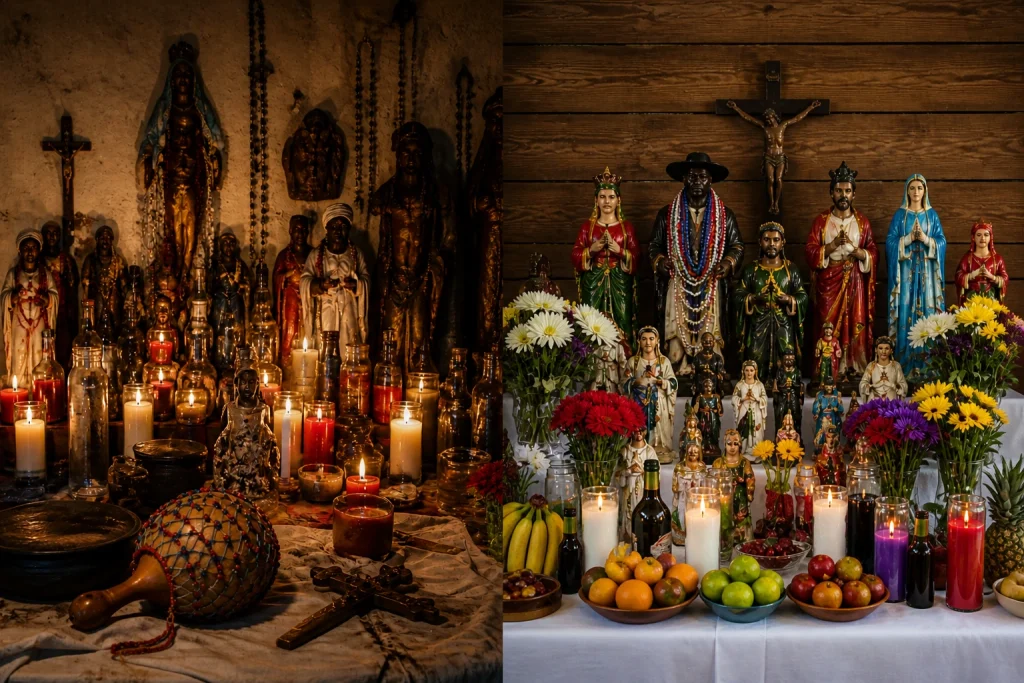
21 Divisions ceremonies, called Horasantas , Mani,velaciones (vigils) and fiestas de misterios, are more adaptable. Perfumes, Florida water, siete potencias, and cigar smoke are central to how work gets done. The Indigenous and African Diaspora Religions in the Americas volume edited by Hebblethwaite and Jansen [7] situates these practices within a wider comparative framework of spirit-based traditions across the Americas, noting both where they converge and where they clearly diverge from Haitian practice.
Language and Cultural Expression
Haitian Vodou operates primarily in Haitian Creole (Kreyòl). Hebblethwaite's work on Vodou songs documents how linguistic preservation in Kreyòl carries African-derived spiritual knowledge forward across generations [1]. Some songs weave in Fon, Yoruba, or Kongo phrases, preserving sounds that have survived centuries of displacement.
21 Divisions runs mainly in Spanish, often mixed with African-derived words and Lucumí phrases depending on the lineage. Peguero Guzmán argues that understanding Dominican Vodou requires placing it firmly inside the context of Dominican popular religiosity, which expresses itself through Spanish-language prayers and invocations that have nothing to do with Haitian Creole [5]. The language difference is not trivial. It reflects centuries of separate formation.
Role of Catholic Influence
Both traditions incorporate Catholicism, but the way each one does it is different enough to matter. Haitian Vodou uses saint imagery largely as spiritual camouflage, a survival strategy developed under colonial surveillance. The essays collected in Vodou in the Haitian Experience: A Black Atlantic Perspective [8] document how this worked as a form of resistance, allowing enslaved Africans to maintain their practices beneath Catholic appearances.
21 Divisions integrates Catholicism more openly and devotionally. It's not camouflage so much as genuine synthesis. Hebblethwaite and Jansen's edited collection includes analysis of Dominican expressions like the Brotherhood of the Holy Spirit of the Kongos of Villa Mella, showing how Catholic elements became thoroughly integrated into the tradition rather than sitting on top of it as protective cover [7].
Priesthood and Spiritual Authority
Haitian Vodou has named, defined roles. A Houngan is a priest. A Mambo is a priestess. Initiation, known as kanzo or sou pwen, follows structured stages. The Haitian Vodou volume includes a chapter by Max-G. Beauvoir describing the holistic medical training that priesthood preparation involves and how deep that preparation goes [2].
21 Divisions recognizes leadership through titles like servidor, caballo de misterio or brujo, and these are based more on accumulated experience than on formalized initiation pathways. Hebblethwaite and Jansen's volume notes that while initiation and spirit possession occur across both traditions, institutional structures diverge significantly, with Dominican spiritual houses often recognizing leadership in more flexible ways [7].
Spirit Possession and Interpretation
Possession sits at the center of both traditions. Maya Deren's classic work Divine Horsemen, referenced in the Vodou in the Haitian Experience collection, documented the structured patterns of lwa possession in Haitian Vodou with ethnographic precision [8]. Hebblethwaite describes possession as a form of embodiment that characterizes spirit-based religions across the African diaspora more broadly [1]. In Haitian Vodou, each lwa manifests in recognizable ways. There is consistency that practitioners can identify.
In 21 Divisions, possession is often called montarse, and the person receiving a spirit is the caballo. The experience can feel more interpretive, less governed by fixed behavioral expectations; with a few exceptions. Hebblethwaite and Jansen's comparative framework acknowledges shared features across both traditions, including service to spirits through ritual, song, and instruments, while also making space for the real divergences between how each tradition understands and enacts the experience [7].
The "Tchatcha" Lineage Connection
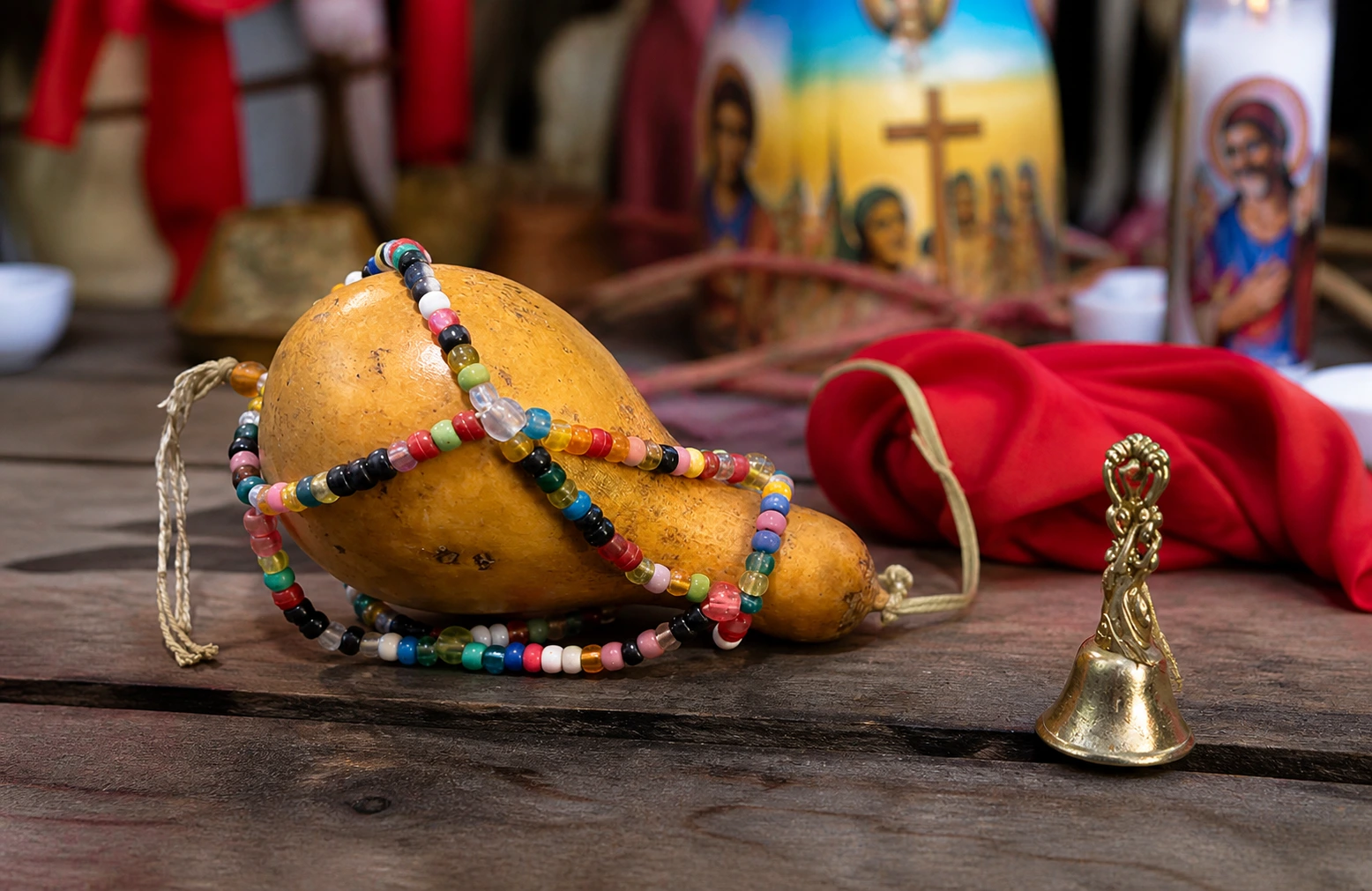
One of the more specific distinctions between the two traditions is the ritual object known as the tchatcha. In Haitian Vodou, the tchatcha is a dried calabash rattle associated especially with the Rada nation. De Heusch and Desquiron's ethnographic documentation from 1970 describes the ritual instruments used in Rada ceremonies, noting calabash rattles among the sacred objects employed to call spirits [6].
Haitian Vodou lineages descending from traditional Rada practice use the tchatcha to call spirits and open ceremony. Some houses are known as sosyete tchatcha, where the rattle takes precedence over drums in certain ritual contexts. Hebblethwaite traces these instrument traditions directly to their African origins in Dahomey, Allada, and Hueda, where calabash instruments held royal and religious functions [1].
In 21 Divisions Dominican Vodou, the tchatcha does not exist as a ritual instrument. Primary instruments are palos, long drums of Congo origin, and ganzás, metal shakers. Santos Rovira's contribution to the Indigenous and African Diaspora Religions volume documents how Dominican traditions like the Brotherhood of the Holy Spirit of the Kongos of Villa Mella use distinct instrumentation that does not include the calabash rattle of Haitian Rada ceremonies [7].
The presence or absence of the tchatcha points somewhere deeper than just instruments. Haitian Rada lineages preserved specific Dahomean ritual technologies intact. 21 Divisions developed in a context where those particular objects either never arrived or were replaced by something else entirely. Scholarly literature on the comparison between these two systems documents this as a key distinguishing feature [3]. When someone says their practice resembles the tchatcha lineage, they are describing something internal to Haitian Vodou, not 21 Divisions.
Key Differences at a Glance
- Structure: Haitian Vodou has documented nanchon/nation organization [4]; 21 Divisions shows more fluid organization [3]
- Spirit names: Lwa (Haiti) vs Misterios (Dominican) [3]
- Language: Haitian Creole with African fragments [1] vs Spanish [5]
- Catholic influence: Symbolic camouflage [8] vs open devotional integration [7]
- Initiation: Structured kanzo [2] vs flexible mentorship [7]
- Ritual symbols: Complex vèvè in Haiti vs simpler offerings in 21 Divisions
- Drumming: Nation-specific patterns [1] vs less standardized [7]
- Indigenous influence: Minimal Taíno in Haitian Vodou vs División India in 21 Divisions [3]
- Tchatcha rattle: Central in Haitian Rada lineages [6] vs absent in 21 Divisions [7]

FAQ
Is 21 Divisions the same as Haitian Vodou?
No. Peguero Guzmán's comparative analysis makes clear they share roots but developed in separate cultural and historical contexts that shaped them differently [3].
Do both traditions work with the same spirits?
Some spirits overlap, but Beauvoir-Dominique and Desmornes have catalogued distinct spirit nations in Haitian Vodou that do not map directly onto Dominican Misterios [4].
Which one is more structured?
Haitian Vodou tends to carry more defined, consistent structure across houses, something that ethnographic studies of the Rada cult document in considerable detail [6]. 21 Divisions allows more variation across lineages [3].
Can someone practice both?
It happens, especially in border regions. Hebblethwaite and Jansen note that while practitioners may draw from multiple traditions, maintaining distinct lineages takes real attention and usually some guidance [7].
What is the tchatcha and why does it matter?
The tchatcha is a calabash rattle used in Haitian Vodou Rada lineages [6]. It has no parallel in 21 Divisions [7], which makes it one of the cleaner ways to distinguish between the two systems.
References
[1] Hebblethwaite, B. (2021). A Transatlantic History of Haitian Vodou: Rasin Figuier, Rasin Bwa Kayiman, and the Rada and Gede Rites. University Press of Mississippi. https://www.upress.state.ms.us/Books/A/A-Transatlantic-History-of-Haitian-Vodou
[2] Bellegarde-Smith, P., & Michel, C. (Eds.). (2006). Haitian Vodou: Spirit, Myth, and Reality. Indiana University Press. https://iupress.org/9780253218537/haitian-vodou/
[3] Peguero Guzmán, L. A. (2000). "Vudú dominicano o vudú en Santo Domingo?" Ciencia y Sociedad, 25(1), 108-142. Instituto Tecnológico de Santo Domingo (INTEC). https://revistas.intec.edu.do/index.php/ciensociedad/article/view/779
[4] Beauvoir-Dominique, R. (2003). "The Twenty-One Nations of Haitian Vodou." In Desmornes, C. H. (2013). Ti Limye sou Vodou. Port-au-Prince: Edisyon ESPAS. https://www.academia.edu/11992765/Ti_Limye_sou_Vodou
[5] Peguero Guzmán, L. A. (1999). "Vudú dominicano o vudú en Santo Domingo?" Boletín Americanista, 49(49), 211-231. Universitat de Barcelona. https://raco.cat/index.php/BoletinAmericanista/article/view/99431
[6] de Heusch, L., & Desquiron, L. (1970). Carnet relatif à des observations et descriptions ethnographiques du culte rada dans le vaudou haïtien. Université Libre de Bruxelles Archives (PP 248-122). http://catalogue.archives.ulb.be/ark:/62888/4k03sz7g
[7] Hebblethwaite, B., & Jansen, S. (Eds.). (2023). Indigenous and African Diaspora Religions in the Americas. University of Nebraska Press. https://www.nebraskapress.unl.edu/nebraska/9781496235727/
[8] Joseph, C. L., & Cleophat, N. S. (Eds.). (2016). Vodou in the Haitian Experience: A Black Atlantic Perspective. Lexington Books. https://rowman.com/ISBN/9781498519135/Vodou-in-the-Haitian-Experience-A-Black-Atlantic-Perspective
Did you find this article helpful?