The 21 Divisions: History, Spirits, and Meaning in Dominican Vodou
The 21 Divisions (known in Spanish as Las 21 Divisiones) form the foundational spiritual system of Dominican Vodou, one of the Caribbean's most sophisticated and often misunderstood religious traditions. Far from being a collection of isolated spirits or a practice of superstition, the 21 Divisions represent a complex cosmology where spiritual forces known as misterios, luases or espíritus are organized into structured families. Each division represents a distinct spiritual vibration, a unique personality archetype, and a specific purpose in the lives of its practitioners.
Some teachings and reflections on this tradition are also available in Spanish. You can explore the Spanish section here: Temas Espirituales.
For people encountering the tradition for the first time, the idea of the 21 Divisions often raises fundamental questions. What exactly are these divisions? Why are there specifically twenty-one? How do they function within daily Dominican spiritual practice, and how do they connect practitioners to their ancestors and the divine?
This comprehensive guide explains the origins, structure, cultural meaning, and contemporary practice of the 21 Divisions in a clear, factual, and respectful manner.
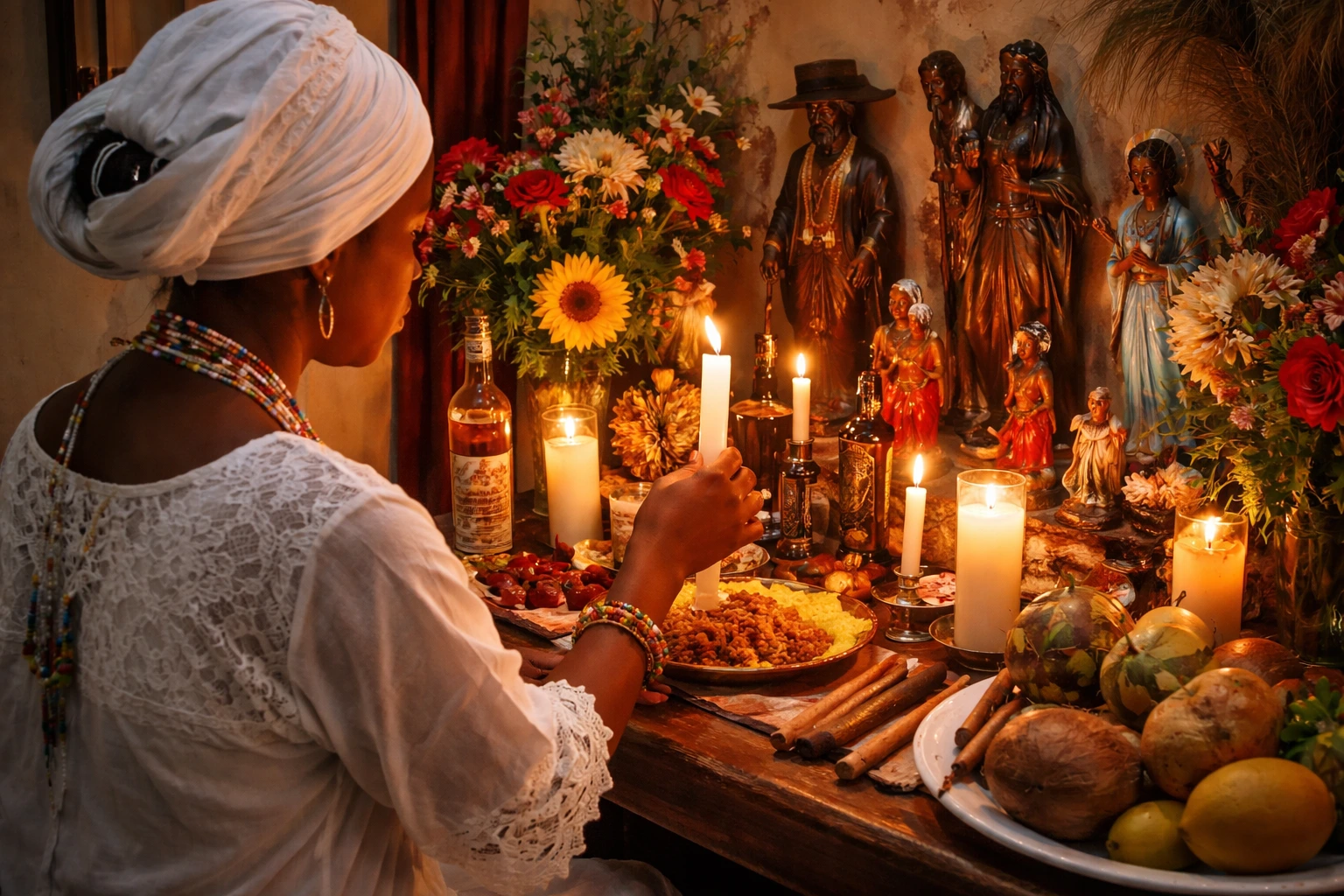
Table of Contents
- Origins of the 21 Divisions
- What the Divisions Represent
- Major Divisions in Dominican Vodou
- Why They Are Called the 21 Divisions
- Cultural Importance in the Dominican Republic
- Common Misconceptions
- The 21 Divisions in Modern Spiritual Practice
- Frequently Asked Questions
Origins of the 21 Divisions
The spiritual system known as the 21 Divisions developed in the Dominican Republic over centuries through a complex process of cultural and spiritual syncretism. This was not a simple blending but a necessary and creative fusion born from the trauma of colonization and the transatlantic slave trade.
Three primary cultural streams converged to create this unique tradition:
- African Spiritual Traditions: Enslaved people brought to the island of Hispaniola from various regions of West and Central Africa (including the Kongo, Yoruba, and Fon peoples) carried their profound spiritual knowledge, including ancestor veneration, spirit possession, and complex cosmologies. The Kongo influence, in particular, is deeply felt in the Dominican tradition, more so than in the Haitian Vodou to the west.
- Roman Catholic Symbolism: Spanish colonizers imposed Catholicism, and enslaved Africans were forced to adopt its forms. To preserve their own beliefs, they practiced a form of religious camouflage, associating their African spirits (misterios) with Catholic saints who shared similar attributes. This is why, for example, the spirit Belie Belcan is often syncretized with Saint Michael the Archangel.
- Taíno and Caribbean Indigenous Beliefs: The indigenous Taíno people of the island had their own spiritual practices, including the worship of zemís (spirits or ancestors). While the Taíno population was decimated, some of their spiritual concepts and rituals likely filtered into the folk beliefs of the general population, adding a distinct local layer to the African and Catholic base.
This fusion created a unique spiritual framework that shares historical roots with other Afro-Caribbean traditions like Haitian Vodou, Cuban Santería, and Brazilian Candomblé, but maintains its own distinct identity, rituals, and pantheon.
What the Divisions Represent
The divisions function as a spiritual classification system, a way to bring order to the vast and diverse spirit world. Instead of treating spirits as isolated entities, the tradition groups them into spiritual families or "nations."
Each division contains spirits with similar temperaments, colors, ritual foods, responsibilities, and modes of manifestation during ceremonies. Some divisions are associated with calm, cool guidance and wisdom, while others represent fiery protection, swift justice, or the raw, transformative power of the crossroads and the cemetery.
This structure is not merely academic; it is practical. It helps practitioners—known as servidores (servers) or caballos (horses, as they are "mounted" by the spirits)—understand which spiritual energies are present during ceremonies, which offerings are appropriate, and how to approach a particular misterio for help with healing, justice, or spiritual consultation.
Major Divisions in Dominican Vodou
Although the system is known as the 21 Divisions, several primary divisions appear most frequently in spiritual practice and are considered the foundational "branches" of the cosmic tree.
The Rada Division
The Rada spirits (often associated with the Dahomey region of Africa) are characterized by their "cool," calm, and benevolent nature. They are the ancient guardians of wisdom, peace, and order. Their energy is stabilizing and constructive. Key figures in this division include Papa Legba (or Libá), the gatekeeper who must be greeted first to open any spiritual communication, and Belie Belcan, a powerful warrior spirit often syncretized with Saint Michael. Rada ceremonies tend to be more formal and structured.
The Petro (Petwo) Division
In contrast to the Rada, the Petwo division is characterized by "hot," intense, and powerful spiritual energy. These spirits are frequently connected with protection, immediate justice, strength, and transformation. Their temperament is more assertive and demanding. They are the spirits who can break curses, provide swift protection, and enact powerful change. The Petwo division includes figures like Ti Jean Petro, a fierce, one-legged spirit of the forest, and Erzulie Danthor, a spirit of justice, wealth, and feminine power, often syncretized with the black madonna.
The Gede Division
The Gede spirits are the guardians of the cemetery and the bridge between the living and the dead. They are connected to ancestors, death, and the mysteries of life and rebirth. They are often approached for guidance related to transitions, breaking through obstacles, and protection from malevolent forces. The Gede are known for their irreverent humor, their love of strong drink and spicy food, and their raw, uncensored speech, which often contains profound wisdom. The leader of the Gede is Baron del Cementerio (Baron of the Cemetery), the stern and powerful judge of the dead.
The Indio Division
This division is a unique feature of Dominican Vodou, reflecting the island's indigenous heritage. The Indio (Indian) division consists of spirits representing the Taíno ancestors. They are often seen as protectors of the land, nature, and natural resources. They are typically considered wise, gentle, and deeply connected to the mountains, rivers, and caves of the Dominican Republic. They are honored with offerings that reflect a pre-Columbian aesthetic, such as cassava, honey, and natural fruits.
Why They Are Called the 21 Divisions
The number twenty-one is deeply symbolic within the tradition and represents a complete spiritual structure rather than a strict numerical list of exactly twenty-one spirits.
The number 21 is often considered a sacred composite, sometimes seen as a multiple of the holy trinities found in both African cosmology (3x7) and Catholic influence. It represents the totality of the spiritual universe. Different spiritual houses (sociedades or societes) and family lineages may organize the divisions slightly differently, sometimes grouping sub-families or honoring regional variations. One house might list the 21 Divisions one way, while another might have a slightly different interpretation.
Therefore, the number reflects completeness and wholeness within the cosmology of the tradition. Rather than referring to a fixed list of twenty-one individual spirits, the name "21 Divisions" represents a full and complete spiritual framework through which an infinite number of spirits and ancestors can manifest.
Cultural Importance in the Dominican Republic
The 21 Divisions continue to play an important and visible role in Dominican cultural and spiritual life, particularly in rural areas and among the diaspora. It is a living tradition, not a relic of the past.
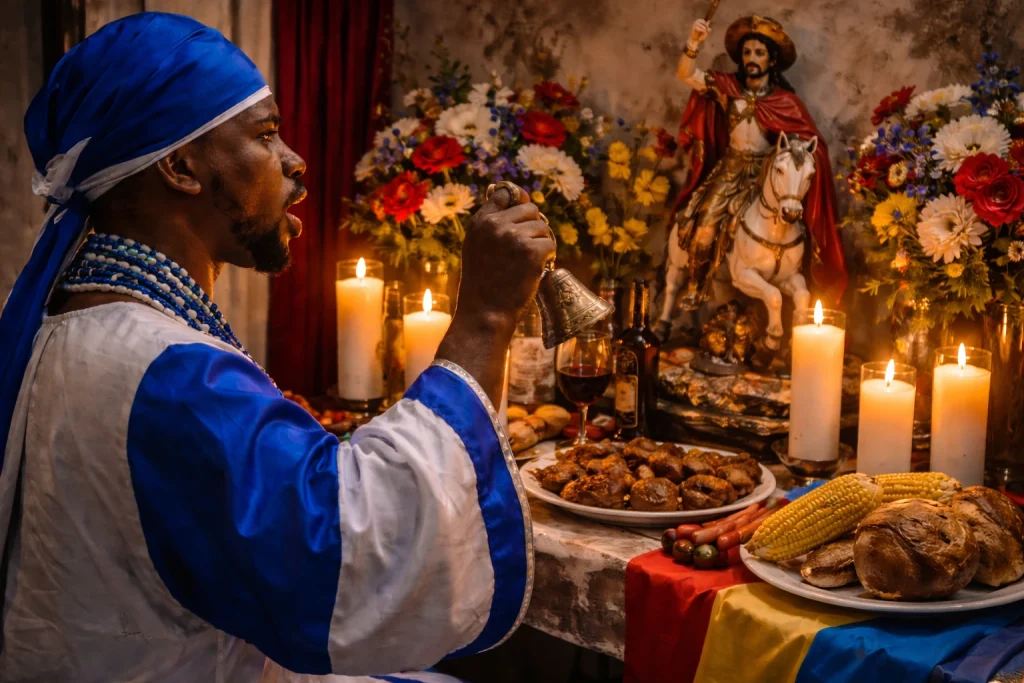
Ceremonies, often held in specialized spaces called peristilos or simply in family homes, are vibrant communal events. They involve:
- Prayer: Including Catholic prayers like the Our Father and Hail Mary, alongside traditional African-influenced invocations.
- Music and Drumming: Specific drum rhythms (palos) are played to invoke different divisions. The drummers are not just musicians but ritual specialists whose rhythms call the spirits down to earth.
- Offerings: These can include fruits, candles, rum, tobacco, perfumes, and the blood of sacrificed animals (usually chickens or goats), which is a traditional life-force offering in many African traditions.
- Spiritual Consultation and Possession: The highlight of many ceremonies is when a misterio "mounts" a practitioner, allowing the community to directly interact with the spirit for advice, healing, and blessings.
For many practitioners, the tradition represents a profound connection to ancestral heritage, a source of community identity, and a practical system for navigating life's challenges. Those interested in deeper, personalized guidance often explore traditions like the 21 Divisions through experienced spiritual counselors. You can learn more about spiritual guidance through spiritual consultations.
Common Misconceptions
Because the tradition developed under colonial conditions and has often been portrayed negatively in popular media, misunderstandings about the 21 Divisions are extremely common.
Misconception 1: It is the same as Haitian Vodou.
While both traditions share historical influences from African and Catholic sources, they developed distinct spiritual structures, rituals, and pantheons. The 21 Divisions is a uniquely Dominican expression, with a much stronger Kongo influence and unique divisions like the Indios.
Misconception 2: It is "devil worship" or "black magic."
This is a colonial-era slander. Dominican Vodou has a comprehensive moral system. Like any religion, it has spirits that can be called upon for protection and justice (like the Petwo), but this is a far cry from "evil." Practitioners seek balance, healing, and guidance, not malevolence.
Misconception 3: The divisions represent competing deities.
In reality, they are better understood as different expressions or "faces" of a single, interconnected divine source. They are not gods at war with one another but distinct energies within one cosmic system, similar to how different archangels in other traditions have different roles.
The 21 Divisions in Modern Spiritual Practice
Today the 21 Divisions remain a vital part of the spiritual landscape of the Caribbean and the growing Dominican diaspora in the United States and Europe. It is adapting to modern life while preserving its core traditions.
Many people study the tradition from historical, cultural, or spiritual perspectives in order to better understand the resilience and creativity of African diaspora spirituality in the Caribbean. It is increasingly being recognized not as a superstition, but as a legitimate and complex religious and philosophical system.
Frequently Asked Questions
What are the 21 Divisions?
The 21 Divisions are the core spiritual classification system in Dominican Vodou that organizes spirits, known as misterios, into different families or divisions based on their origins, characteristics, and functions. It is the name for the tradition itself.
Are the 21 Divisions the same as Haitian Vodou?
No. While both traditions share historical roots in West and Central African spirituality and Catholicism, Dominican Vodou (Las 21 Divisiones) developed its own unique structure, spirits (such as the Indio division), and ritual practices.
What are the spirits called in the 21 Divisions?
In Dominican spiritual tradition, the spirits are most commonly called misterios (mysteries), but also luases (from the French l'heure, meaning "the hours," or "the spirits") or santos (saints). Each belongs to a specific division within the spiritual system.
Why is the number twenty-one used?
The number twenty-one represents a symbolic structure that reflects completeness and wholeness within the spiritual cosmology of the tradition, rather than a literal list of only twenty-one spirits. Different spiritual houses may have slightly different interpretations of the 21 groups.
Is the 21 Divisions tradition a religion?
Yes, for many practitioners the tradition is both a complete religion and a cultural identity, connecting communities with their ancestors, providing a moral framework, and offering a way to interact with the divine. It is a full spiritual path rooted in Caribbean heritage.
What is the role of Catholic saints in the 21 Divisions?
Catholic saints serve as a surface representation or "mask" for the deeper misterios. This syncretism was a historical necessity for survival under colonial rule and continues to be a meaningful layer of practice for many, illustrating the blending of the two faiths.
If you found this guide helpful, follow for more discussions on spirituality, Afro-Caribbean traditions, and personal growth.
📘 Facebook.com/espirituales | 📸 Instagram.com/rubenricart